
AI answers
SEO, AIO, GEO, LLMO and AEO: differences and where to start
Short answer
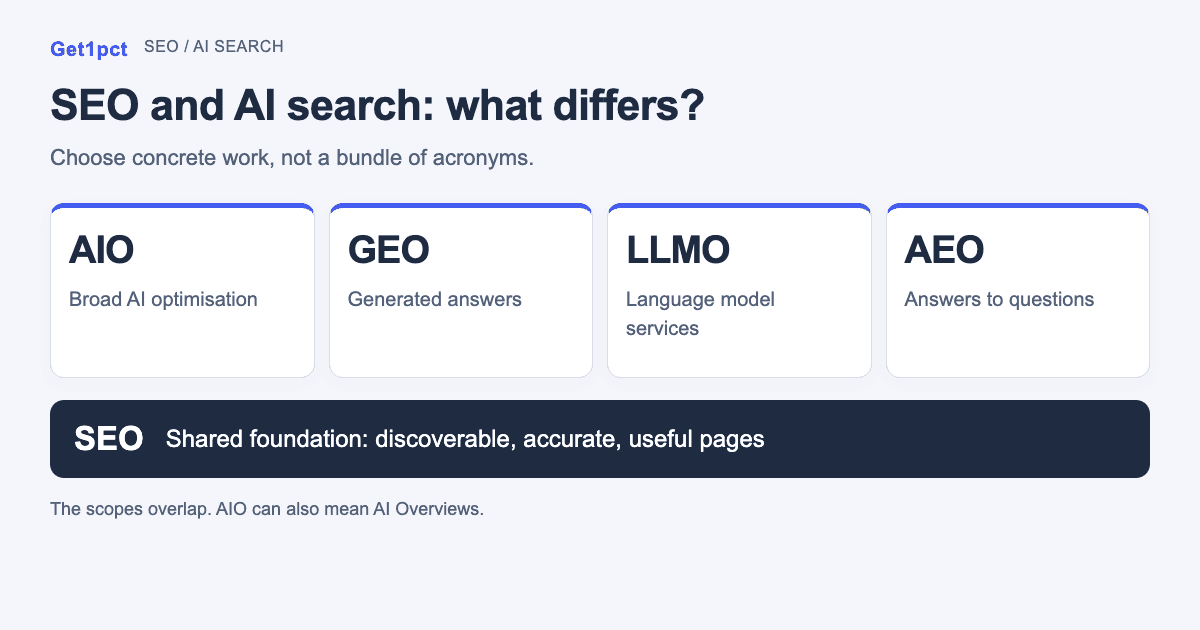
SEO helps search engines discover and understand your website. AIO, GEO, LLMO and AEO describe overlapping interests in AI discovery and answers. They are not five independent packages you must buy. Start with an accessible website, accurate service information and a working enquiry route, then add observation for the search experiences your customers use.
Check the supported features and availability: Features
What each term covers
This is our working classification, not an industry standard. Ask a supplier which platform, pages, changes and measurements their proposal actually covers.
| Term | Main focus | Useful work |
|---|---|---|
| SEO · Search Engine Optimization | Discovery and understanding in search, including the foundation of AI search | Fix indexing problems and descriptive page titles |
| AIO · AI Optimization | A broad label for improving how AI services understand or present information | Keep business details consistent |
| GEO · Generative Engine Optimization | References and citations in generated answers | Publish original evidence and clear service conditions |
| LLMO · Large Language Model Optimization | How LLM-based services represent a business | Record incorrect answers and inspect their sources |
| AEO · Answer Engine Optimization | Being found as an answer to a question | Explain the answer, conditions and evidence together |
AIO is ambiguous; GEO and LLMO overlap
AIO can also mean Google’s AI Overviews, a product feature rather than an optimisation discipline. Ask whether “AIO work” means AI Overviews, AI Mode or several different AI services. AEO also has a wider history in direct answers; these labels do not establish separate technical requirements.
GEO focuses on generated answers; LLMO focuses on services using large language models. Their practical work can overlap. LLMO is not a single, independent ranking system. A model answering from learned knowledge and a service retrieving current web pages are different cases: editing a page does not immediately rewrite every model or answer.
Keep the SEO foundation; choose the work by the problem
Google’s official guide keeps SEO as the foundation for its generative search features. Check indexing, snippet eligibility and Search Console’s Search generative AI setting, including inherited controls. Meeting the conditions does not ensure display. Google Search does not require llms.txt or special schema markup. Other services need their own documentation checked.
Our hypothetical example is a plumbing business. If its service page cannot be found, investigate crawling and indexing before commissioning articles. If visitors cannot tell whether emergency callouts are offered, clarify the actual hours, area and conditions. For local discovery, keep its Business Profile consistent. These are suggested priorities, not measured results.
- Technical SEO: check status codes, noindex, canonical URLs, internal links and the sitemap.
- Content: add genuine job evidence, service limits and a responsible contact.
- Local SEO: verify the relevant business profile; do not invent locations.
- Conversion measurement: confirm the enquiry form works and define what counts as an enquiry.
Work to refuse
Google’s spam policies cover manipulative links, keyword stuffing, cloaking and scaled content abuse. Our advice is also to reject fabricated customer reviews, invented credentials and hidden instructions intended to manipulate AI answers.
- Do not buy links or arrange bulk exchanges to manipulate rankings.
- Do not repeat towns or keywords unnaturally, including in hidden text.
- Do not mass-produce near-identical pages with no useful local detail.
- Do not show deceptive content differences to search engines and people.
- Do not accept promises of first place or certain AI citations.
AI-assisted drafting is not automatically a violation. Check facts, permissions and added value before publishing. A large number of generated pages is not a substitute for useful information.
Measure visibility and business outcomes separately
Checked on 17 November 2026: Search Console documents a generative AI performance report for impressions in AI Overviews and AI Mode. It may be absent when there are too few impressions. Bing AI Performance aggregates citations across supported experiences. Neither is a complete log of every AI answer.
Separate impressions, brand mentions, URL citations, visits and enquiries. Referral information can be missing. When testing answers manually, save the question, service, date, region, login state and cited URLs. A small prompt sample is not a market-wide citation rate. Before-and-after changes do not prove causation: demand, competitors and system changes can also matter.
More AI search terms, checked in November 2026
These names describe different things: marketing approaches, technical mechanisms and measurements. Some predate 2026. Learning the vocabulary does not mean buying another optimisation package.
- AI SEO and GAIO: AI SEO can mean using AI to do SEO, or improving a site for AI search. GAIO means Generative AI Optimization, an industry label overlapping GEO and LLMO. It is not a separate official Google ranking system. Ask what work the supplier actually proposes.
- RAG and grounding: Retrieval-Augmented Generation uses retrieved information to help generate an answer. Grounding means basing an answer on information such as external sources. A page being retrieved, used in an answer and shown as a clickable citation are different observations.
- Query fan-out: a system runs related searches to address the original question. In our hypothetical repair business example, it might explore cost, methods and service conditions. This is not a reason to mass-produce a thin page for every possible wording.
- AI visibility and AI share of voice: AI visibility covers how a business appears; AI share of voice measures brand presence in a tracked answer set, often as a proportion relative to competitors. Definitions vary by tool. Check the tracked questions, platforms, locations, period and denominator. Brand mentions, URL citations and visits are different measurements.
- Citation Share: Bing describes the proportion of citations attributed to your site for a particular grounding query. It is not a share of the entire AI market, a ranking or a quality score. Similar names in other tools may use different scopes.
Agentic search, MCP and WebMCP are different from ranking work
Agentic search describes contexts where AI goes beyond finding information to carry out tasks such as comparison or interaction. Appearing in search and enabling an agent to complete a website task are separate problems. We suggest starting with labelled forms, clear buttons, stable layouts and accurate service conditions.
MCP, Model Context Protocol, connects AI applications to external data and tools. WebMCP is a proposed browser-oriented web standard for pages to expose tools to agents; it is not the same protocol. Check compatibility and permissions. Implementing either does not establish a ranking or citation benefit.
New product names: Business Hub and Business Agents
OpenAI announced Businesses in ChatGPT in beta on 10 November 2026. Business Hub lets eligible businesses manage information and see aggregated insights. Business Agents provide business-specific conversations, initially for eligible US ecommerce and online service businesses.
A managed business profile, its agent and ChatGPT’s independent answers are distinct. Do not assume the same features are available in every country or category; check current eligibility before applying. This explanation does not mean Get1pct offers registration, verification or agent management.
The services Get1pct uses, and what each is good at
We separate investigation, drafting and approved changes. These are implementation roles, not a claim that Get1pct operates every feature in each external tool.
- Search Console: permitted query, impression and click data helps identify pages to review. Access is read-only; it does not change Google settings.
- GA4: aggregated acquisition, landing-page and configured key-event data can inform suggestions. Search Console clicks and GA4 sessions use different counting rules.
- PageSpeed Insights: the diagnostic checks mobile performance. Distinguish available field data from Lighthouse lab measurements. A performance score is not a search ranking or a verdict on the whole website.
- OpenAI: page content and permitted aggregates inform draft changes and reasons. The user checks business facts and conditions before accepting a suggestion.
- WordPress or copy-and-edit: selected, approved changes can be applied to supported fields on a connected WordPress site. Other changes can be copied into an editor. CMS access and read-only Google access are separate connections.
Four useful ways to put Search Console to work
Its strength is Google-reported queries, impressions, clicks and indexing information for your own site. It is not a complete competitor database or market-wide search-volume tool. These are our suggested workflows; use the relevant external tool interface for the checks.
- Impressions but few clicks: select a page and query, then align country, device and dates. Check whether the content answers the intent before changing its title. Low CTR alone is not a diagnosis. Read the detailed steps: How to use Search Console: choose a page without misreading CTR
- Unsure what to write: inspect actual question queries and look for missing answers or conditions on an existing page. Do not invent a service or create a separate article for every wording. Read the detailed steps: Find question queries in Search Console and improve the answer
- Two pages for one query: examine their roles and intent through the query-to-pages view. Multiple URLs alone do not prove a problem; do not immediately delete or merge them. Read the detailed steps: Two pages rank for one query: what to check before merging them
- After publishing: distinguish the indexed state from a live URL test. Record the change date and compare like-for-like after reprocessing, considering seasonality. Configured GA4 key events provide separate evidence about visits after the click. Read the detailed steps: How to add an annotation in Google Search Console
Some queries are omitted and recent data may be preliminary. Live tests and indexing requests do not ensure indexing or display. Google’s generative search report is useful within its documented scope, not for measuring mentions across every AI service.
Read the detailed steps: Separate branded queries in Search Console without misreading CTR
A checklist for one useful change
Choose one service page. This is our suggested workflow, not an official AI eligibility score.
- Write who the service is for, where it operates and what it excludes.
- Answer one real question using verified conditions and evidence.
- Check titles, internal links, public access and the enquiry route.
- Record the URL, change date, previous wording and next measurement.
Continue with the related SEO and GEO practical guide for implementation. Get1pct’s availability and signup options are shown in the site’s local interface; this guide does not promise automatic fixes or results.
Common questions
Should I replace SEO with GEO? Keep the common foundation and add observation where customers actually look. Choose concrete work rather than a collection of acronyms.
Is FAQ structured data required for AEO? No. Put useful answers where readers need them. FAQ formatting or markup does not ensure selection.
Is llms.txt essential? Google Search explicitly says it is unnecessary. Check other services separately; do not sell a file as a citation guarantee.
Can one AI query prove progress? It is a spot check. Record the conditions and compare it with broader platform and business data.
Related fundamentals and practical guides: SEO, AIO and GEO glossary: why SEO matters and what to check / Free PR sites by country: press releases and product listings
Sources
- Google: Generative AI search guide
- Google: Spam policies
- Google: Using generative AI content
- Search Console: Search generative AI control
- Search Console: Generative AI performance report
- Bing: AI Performance
- Bing: Citation Share
- OpenAI: Businesses in ChatGPT (2026-11-10)
- Chrome: WebMCP and MCP
- MCP: Introduction
- web.dev: Agent-friendly websites
- IONOS: GAIO — terminology example
- Scrunch: AI share of voice — metric example
- Google: Search Console performance
- Google: URL Inspection
- Google: Search Console and Analytics
- Google: PageSpeed Insights